


Dissertation Topic
From Hopewell to New Echota: Cherokee Sovereignty, Diplomacy, and the Hiwassee Garrison, 1785–1838

Southwest Point, in Kingston, TN Cherokee Agency in Tennessee from 1801-1806
The prevailing narrative of Cherokee history remains dominated by removal and the Trail of Tears. While the forced migration of 1838 stands as a defining moment in the history of the Cherokee Nation, the decades preceding removal reveal a far more complex political landscape. During the Early Republic, Cherokee leaders pursued diplomacy, constitutional reform, educational initiatives, economic development, and nation-building while navigating increasing pressure from the federal government and the neighboring states of Georgia, Tennessee, and North Carolina. At the center of many of these developments stood the Hiwassee Garrison, a federal post established in 1806 on the Hiwassee River in southeastern Tennessee. Although often mentioned only briefly in broader histories, the garrison functioned as a diplomatic, administrative, and cultural crossroads where Cherokee leaders, federal officials, missionaries, traders, and military officers interacted. This dissertation, From Hopewell to New Echota: Cherokee Sovereignty, Diplomacy, and the Hiwassee Garrison, 1785–1838, argues that the Hiwassee Garrison played a formative role in Cherokee-American relations and offers a unique vantage point for examining the practice of Cherokee sovereignty.

Site of Hiwassee Garrison near Dayton, TN Cherokee Agency in Tennessee from 1801-1815
The project originated from a deceptively simple question: why has a site associated with Return J. Meigs, Gideon Blackburn, John Ross, Sam Houston, and several major developments in Cherokee history received so little sustained scholarly attention? As research progressed, the significance of the Hiwassee Garrison became increasingly clear. Situated within the Cherokee Nation and serving as the headquarters of the Cherokee Agency, the garrison occupied a strategic position where federal policy, Cherokee diplomacy, missionary activity, and local politics converged. Far from functioning merely as a military outpost, it became a center of communication, negotiation, and political experimentation during a critical period in Cherokee-American relations. The site also provides an opportunity to examine larger questions concerning Cherokee sovereignty, federal authority, and state power that increasingly defined relations between the Cherokee Nation and the United States during the first decades of the nineteenth century.
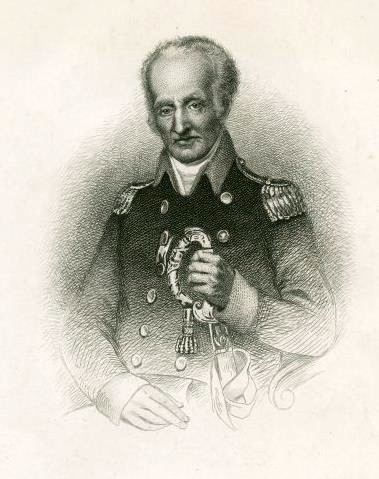
Colonel Return Jonathan Meigs, Cherokee Agent in Tennessee from 1801-1821
This dissertation addresses several interrelated research questions. How did the Hiwassee Garrison shape the development of Cherokee-American diplomacy during the Early Republic? In what ways did Cherokee leaders employ negotiation, adaptation, and political innovation to preserve sovereignty amid shifting geopolitical pressures? How did federal officials such as Return J. Meigs navigate the competing demands of the Cherokee Nation, the federal government, and neighboring states? To what extent did debates over Cherokee sovereignty reflect broader tensions between federal authority, state power, and competing understandings of sovereignty in the Early Republic? Finally, how did the interactions at Hiwassee contribute to the broader transformation of Cherokee-American relations from the Treaty of Hopewell in 1785 to the Treaty of New Echota in 1835 and the removal crisis that followed?

John Ross, Chief of the Cherokee, 1828-1866
The significance of this project lies in its focus on sovereignty as an active and negotiated process rather than simply a legal concept or a narrative overshadowed by removal. Rather than viewing sovereignty solely through treaties and court decisions, this project examines how Cherokee sovereignty functioned in everyday interactions among Cherokee leaders, federal agents, missionaries, and local communities. Recent scholarship in Indigenous history, borderlands studies, and political history has emphasized Native agency and the centrality of Indigenous diplomacy to early American state formation. Scholars such as William G. McLoughlin, Theda Perdue, John Finger, Gregory Ablavsky, David Wilkins, Pekka Hämäläinen, and Kathleen DuVal have demonstrated that Native nations actively shaped the political landscape of North America. While this scholarship has highlighted the importance of Native diplomacy and sovereignty, the Hiwassee Garrison offers an opportunity to examine how those ideas operated on the ground in a place where Cherokee leaders, federal officials, and missionaries regularly met. Through these interactions, broader questions concerning nationhood, citizenship, education, religion, and political authority become visible in ways that are often obscured in national narratives.

Sam Houston lived with his adopted Cherokee Father, John Jolly on Hiwassee Island, across from Hiwassee Garrison. Later, Sam Houston would become a Cherokee Sub-Agent and help negociate the Treaty that would John Jolly signed in 1817 to take him to Arkansas Territory in 1819.

Chief John Jolly, adopted a young Sam Houston, lived on Hiwassee Island overlooking the Hiwassee Garrison
Methodologically, the project integrates documentary research with approaches from Indigenous, borderlands, political, and religious history. It relies on manuscript collections, treaty records, agency correspondence, missionary papers, government documents, newspapers, and published primary-source collections. Particular emphasis will be placed on the records of the Cherokee Agency, the papers of Return J. Meigs, correspondence associated with Gideon Blackburn and the American Board of Commissioners for Foreign Missions, federal treaty negotiations, and contemporary newspaper accounts from both Cherokee and American communities. These sources make it possible to reconstruct not only policy decisions but also the relationships, negotiations, and conflicts that shaped everyday interactions between Cherokee leaders and representatives of the United States.

Gideon Blackburn, a presbyterian minister from Blount County, was appointed as Superintendent of Cherokee Schools by The Glass and Thomas Jefferson. He was a minister to Sam Houston's mother.
A borderlands framework guides the analysis. Rather than conceptualizing the Hiwassee region as a fixed frontier separating two distinct societies, the dissertation approaches it as a lived landscape where Cherokee leaders, federal officials, missionaries, traders, and settlers interacted on a regular basis. The Hiwassee Garrison occupied the center of this contested space, making it possible to examine how sovereignty, diplomacy, and authority were negotiated in practice rather than merely debated in treaties and government documents. This framework moves beyond narratives that portray Native peoples primarily as subjects of federal policy. Instead, Cherokee leaders emerge as political actors who negotiated treaties, managed internal divisions, interacted with missionaries, and pursued strategies designed to preserve the sovereignty of the Cherokee Nation. The approach also highlights the fluidity of jurisdiction, the permeability of political boundaries, and the improvisational nature of diplomacy in the Early Republic. By examining these interactions within a borderlands context, the project seeks to demonstrate that sovereignty was continuously negotiated rather than simply asserted or denied.

The students at the Cherokee School wrote to Thomas Jefferson. Thomas Jefferson also told the Cherokee it was good to learn about how to create their own government from Return J. Meigs.
The researcher is uniquely positioned to undertake this study. More than a decade of engagement with Cherokee history has fostered familiarity with the people, places, and questions that animate this project. Growing up in Oklahoma, where Cherokee history remains highly visible, cultivated an early interest in the Cherokee Nation. Family connections to the communities where Sam Houston later settled in Texas encouraged further exploration of the relationship between Cherokee history, westward migration, and the broader development of the American South and Southwest. Later experiences in Tennessee, including residence near the former site of the Hiwassee Garrison, revealed the historical significance of a location often overlooked in the literature. Service with the Tennessee Trail of Tears Association, work with the Sequoyah Birthplace Museum, and collaboration with Native communities and historical organizations in Tennessee and Texas further deepened an interest in the connections between the Hiwassee Garrison, Cherokee diplomacy, Sam Houston, John Jolly, Return J. Meigs, and the broader development of Cherokee sovereignty. What began as an effort to understand the history of a little-known frontier post evolved into a larger investigation of how competing claims of authority, sovereignty, and nationhood shaped Cherokee-American relations.

Typical Cherokee cabins as seen at nearby Red Clay
Ultimately, this dissertation argues that the Hiwassee Garrison was far more than a military installation on the Cherokee frontier. It was a center of diplomacy, religion, education, and political negotiation where competing visions of sovereignty were articulated, contested, and transformed. By examining Cherokee-American relations from Hopewell to New Echota through the lens of the Hiwassee Garrison, this study seeks to contribute to ongoing discussions concerning Indigenous sovereignty, federal Indian policy, and the complex processes of nation-building in the Early American Republic. In doing so, it argues that Cherokee removal was not the beginning of the story but the culmination of a decades-long struggle over sovereignty, diplomacy, and political authority that unfolded long before 1838.

Map of Cherokee Lands in present Tennessee from 1818. Note "Highwassee Garrison" is at the convergence of the Tennessee and "Highwassee" rivers. The "U. S. Agency for the Cherokees" was the new Cherokee Agency on Agency Creek, shown mid-page. The Cherokee Agency would move again, further down the "Highwassee" in 1821 to present day Charleston, TN before the removal of 1838. Southwest Point is on the northern border at the top, "S. W. Point."


Comments