


The Montgomery Family of Original Montgomery County Texas
- Jun 30, 2023
- 6 min read
Abstract
The tales of Texas pioneers are vast. The Montgomery Clan came to Texas starting in 1820 with the Long Expedition. They settled in Stephen F. Austin's Colony and fought in the Texas Revolution. Today, Montgomery County stands where they once lived. Their stories and times legend with those who fought for freedom in an inhospitable and often hostile climate. Our Montgomery family was a part of that story.
Blog Post
The Montgomery family first stepped foot in Texas from South Carolina, Tennessee, Alabama, and Arkansas with Andrew Montgomery and "expeditions" as early as 1820.[1] More than likely, these expeditions were a part of the Long Expedition of 1820.[2]
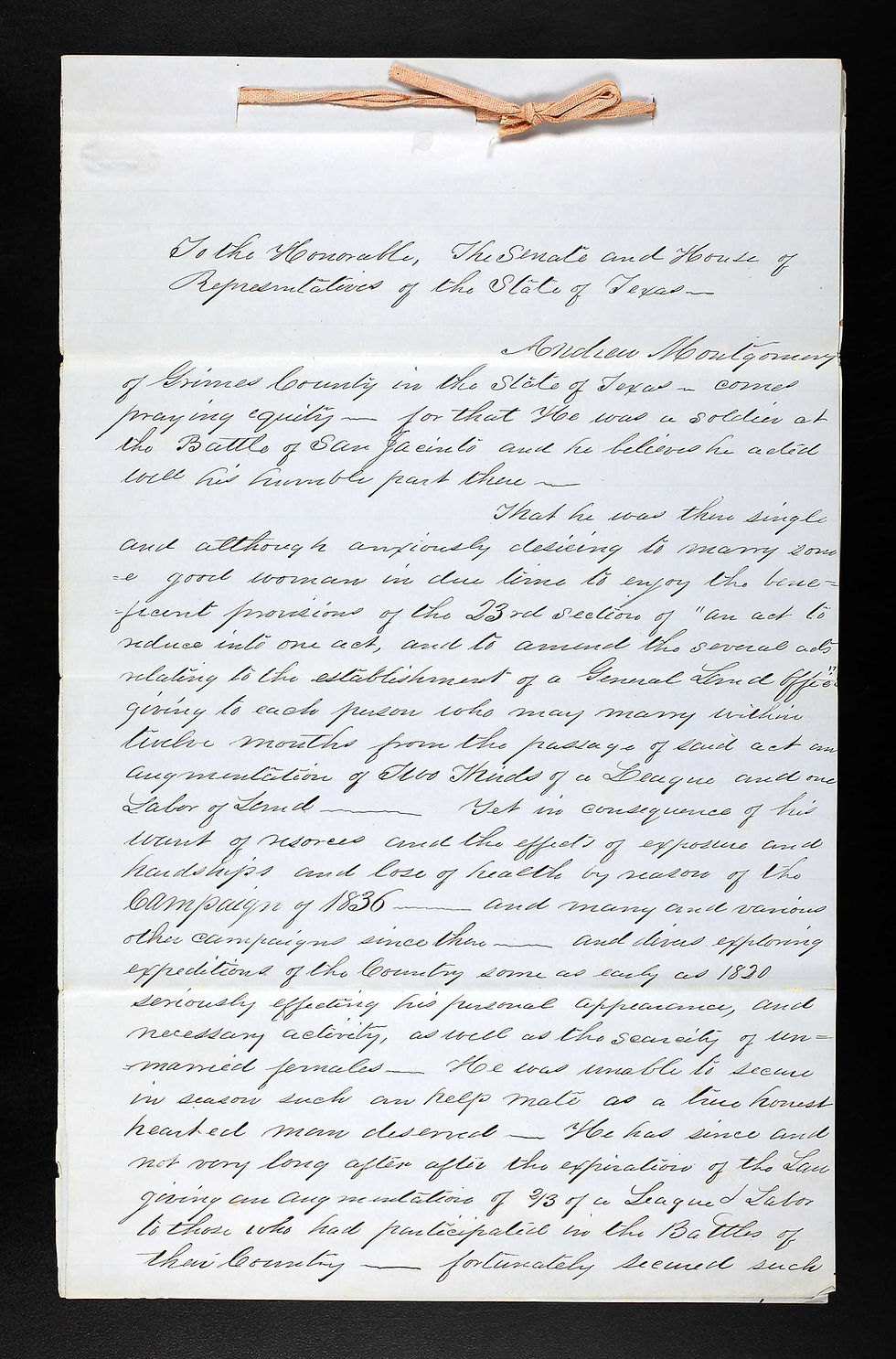
States the Andrew was in the Battle of San Jacinto and was in early expeditions of the country, some as early as 1820. Andrew Montgomery, “Petition for Augmentation of Land” (Texas, U.S., Memorials and Petitions, 1834-1929 - Ancestry.com, November 13, 1855), https://www.ancestry.com/discoveryui-content/view/179:2218?ssrc=pt&tid=161928586&pid=262496623246.
Andrew Montgomery was the son of William Montgomery (1772-1836) and the grandson of Andrew Ewing (or Ewin) (1740-1813),[3] who was a signer of the Cumberland Compact and the appointed clerk.[4] One of Andrew Ewing's other grandsons, the son of Edley Ewing who also came to Texas, James Ewing, would die at the Alamo.[5]

Andrew Ewing, a signer of the Cumberland Compact, was the grandfather of Andrew Montgomery. Richard Carlton Fulcher, 1770-1790 Census of the Cumberland Settlements: Davidson, Sumner, and Tennessee Counties (in What Is Now Tennessee) (Baltimore, Maryland: Genealogical Publishing Com, 1987), 35.

Gary Zobly's drawing of James Ewing (left) at the Alamo. Few know his true story. Find a Grave, “James L. Ewing (1812-1836),” Find a Grave, 2020, https://www.findagrave.com/memorial/8862246/james-l-ewing.
The family settled in the area of later Montgomery County (now comprised of portions of six counties: Montgomery, Grimes, Walker, Madison, San Jacinto, and Waller) prior to Stephen F. Austin's awarding of land grants in the area in the early 1830s.[6] The members of the family were many: William Montgomery, John Montgomery, and his sister Margaret Montgomery were of the elder generation of the group, the children of John Joseph Montgomery and Rachel Elizabeth Rush (sister of Benjamin Rush, signer of the Declaration of Independence).[7]

Rachel Rush, the sister of Benjamin Rush, a signer of the Declaration of Independence, married Joseph Montgomery. They were the parents of William and Margaret Montgomery who came to Texas in the 1820s. George Norbury MacKenzie, Colonial Families of the United States of America: In Which Is Given the History, Genealogy and Armorial Bearings of Colonial Families Who Settled in the American Colonies from the Time of the Settlement of Jamestown, 13th May, 1607, to the Battle of Lexington, 19th April, 1775, vol. 6 (Grafton Press, 1917), 407.
William Montgomery came as a widow to Texas in 1822[8] and brought his grown-up sons Andrew (married Mary Farris), Edley (married Emeline Farris), and John (Julia Robinson) as well as his daughters Elizabeth (married J.G.W Pierson), Mary Jane (married Franklin Greenwood), Anna, (married Joel Greenwood), and little Sarah (married John McGuffin). Margaret Montgomery came with her husband Owen Shannon and her children John (married Louisa Compton), Jacob (married Catherine Yoakum), Ruth (married James William Miller), Eleanor (married Jonas Harrison), and Nancy Hannah, (married Charles Garrett). Almost the adult children (save little Sarah) received land grants, daughters with their husbands, in Stephen F. Austin's Colony (in original Montgomery County).[9] Andrew Montgomery, my third great grandfather, was a government surveyor for the state of Coahuila and Texas during the Mexican period (1821-1836), along with my third great uncle J.G.W. Pierson.[10]

William Montgomery in Texas in 1822. B. B. Goodrich, “Montgomery County Clerk Returns 0000002” (Texas GLO, March 1838), https://s3.glo.texas.gov/ncu/SCANDOCS/archives_webfiles/arcmaps/webfiles/landgrants/PDFs/1/0/6/2/1062186.pdf.

Montgomery family land grants in Original Montgomery county see Texas Center for Regional Studies, “Montgomery,” Historical, Texas Center for Regional Studies, 2019, http://www.texascenterforregionalstudies.net/montgomery.html.
In the wake of the oncoming Texas Revolution, the provisional governor of Texas, James W. Robinson, wrote to J.G.W. Pierson (husband of Elizabeth Montgomery), to recall to him that his district had been surveyed by many of the citizens of Montgomery and Grimes Prairie and to bring them to the fight.[11] J. G. W. Pierson, Andrew Montgomery, and John Montgomery and well as their uncle Hezekiah Faris all fought in the Battle of San Jacinto on April 21, 1836.[12]

Roberston to Pierson, 4350. February 13, 1836. John H. Jenkins, Papers of the Texas Revolution, vol. 9 (Austin, TX: Presidial Press, 1973), 156–57, archive.texashistorytrust.org/view/862740855/.
There are many theories as to the naming of the town of Montgomery that was built where the old Montgomery family lived from the 1820s on: James Montgomery, Margaret Montgomery, William Montgomery, Andrew Montgomery and even our cousins General Richard Montgomery of the Revolutionary War or Lemuel Montgomery of the War of 1812. Some say it was named for Montgomery, Alabama (which was named for our cousin Lemuel). Whatever the case, the name of Montgomery is still spoken in these parts though they are long gone. There are many more stories, but in the end, the Montgomerys and their legacy are still remembered.

Andrew and Edley Montgomery, brothers, family photo files, both died in 1864 in Original Montgomery County. Edley Montgomery was one of the first Texas Rangers.
Today in 2023, as I write this, descendants of these colonists still live in the area where they settled so long ago. I am descended from William Montgomery, by his son Andrew, by his son John, by his son John Lee, by his son James Troy, by his son Robin Navarro, to me,a daughter, Joy Montgomery. I have kept my family name, as has my sister, and we are carrying on the history still today in preservation, restoration, and celebration in this land they call Texas.
Notes
[1] November 13, 1855. Andrew Montgomery writes for an augmentation of land after fighting at the battle of San Jacinto as a single but now married man. He cites the 23rd section of the "establishment of the General Land Office Act" to as for two-thirds labor of land. He states he was on expeditions in the country of Texas, some as early as 1820. Andrew Montgomery, “Petition for Augmentation of Land” (Texas, U.S., Memorials and Petitions, 1834-1929 - Ancestry.com, November 13, 1855), https://www.ancestry.com/discoveryui-content/view/179:2218?ssrc=pt&tid=161928586&pid=262496623246.
[2] The Long Expedition was an attempt by a group of Anglo-Americans to take over Texas from Spain in 1820. Harris Gaylord Warren, “Long Expedition,” in The Handbook of Texas (Texas Historical Association, July 19, 2017), https://www.tshaonline.org/handbook/entries/long-expedition.
[3]Richard Carlton Fulcher, 1770-1790 Census of the Cumberland Settlements: Davidson, Sumner, and Tennessee Counties (in What Is Now Tennessee) (Baltimore, Maryland: Genealogical Publishing Com, 1987), 35.
[4] Andrew Ewin, “Records of the Cumberland Association,” The American Historical Magazine and Tennessee Historical Society Quarterly 7, no. 2 (1902): 116.
[5]Find a Grave, “James L. Ewing (1812-1836),” Find a Grave, 2020, https://www.findagrave.com/memorial/8862246/james-l-ewing.
[6]B. B. Goodrich, “Montgomery County Clerk Returns 0000002” (Texas GLO, March 1838), https://s3.glo.texas.gov/ncu/SCANDOCS/archives_webfiles/arcmaps/webfiles/landgrants/PDFs/1/0/6/2/1062186.pdf.
[7]George Norbury MacKenzie, Colonial Families of the United States of America: In Which Is Given the History, Genealogy and Armorial Bearings of Colonial Families Who Settled in the American Colonies from the Time of the Settlement of Jamestown, 13th May, 1607, to the Battle of Lexington, 19th April, 1775, vol. 6 (Grafton Press, 1917), 407.
[8]Goodrich, “Montgomery County Clerk Returns 0000002,” 8.
[9] Original Montgomery County, Texas broke off from Washington Municipality in 1837. The list of citizens of Washington Municipality as of 1836 is listed in: Worth S. Ray, Austin Colony Pioneers: Including the History of Bastrop, Fayette, Grimes, Montgomery, and Washington Counties and Their Earliest Settlers. (Austin, TX: the Author, 1949), 21–24. To see the image of the Montgomery land grants in Original Montgomery county see Texas Center for Regional Studies, “Montgomery,” Historical, Texas Center for Regional Studies, 2019, http://www.texascenterforregionalstudies.net/montgomery.html.
[10]Sue Watkins, ed., One League to Each Wind: Accounts of Early Surveying in Texas (Austin, TX: Von-Boeckmann-Jones, 1964), 31.
[11] Roberston to Pierson, 4350. February 13, 1836. H. Jenkins, Papers of the Texas Revolution, vol. 9 (Austin, TX: Presidial Press, 1973), 156–57, archive.texashistorytrust.org/view/862740855/.
[12] While the soldiers listed in the book are accurate, many of the biographies, such as that of Andrew Montgomery, are not. The book states that Andrew was living in Mississippi in 1843, however, we know he never lived there in later years. Andrew's 1855 petition attests to his attendance at San Jacinto. Sam Houston Dixson and Louis Wiltz Kemp, The Heroes of San Jacinto (Houston, Texas: Anson Jones Press, 1932), 403.
Bibliography
Dixson, Sam Houston, and Louis Wiltz Kemp. The Heroes of San Jacinto. Houston, Texas: Anson Jones Press, 1932. https://www.familysearch.org/library/books/viewer/772973/?offset=0#page=2&viewer=picture&o=search&n=0&q=montgomery.
Ewin, Andrew. “Records of the Cumberland Association.” The American Historical Magazine and Tennessee Historical Society Quarterly 7, no. 2 (1902): 114–35.
Find a Grave. “James L. Ewing (1812-1836).” Find a Grave, 2020.
Fulcher, Richard Carlton. 1770-1790 Census of the Cumberland Settlements: Davidson, Sumner, and Tennessee Counties (in What Is Now Tennessee). Baltimore, Maryland: Genealogical Publishing Com, 1987.
Goodrich, B. B. “Montgomery County Clerk Returns 0000002.” Texas GLO, March 1838. https://s3.glo.texas.gov/ncu/SCANDOCS/archives_webfiles/arcmaps/webfiles/landgrants/PDFs/1/0/6/2/1062186.pdf.
Jenkins, John H. Papers of the Texas Revolution. Vol. 9. 9 vols. Austin, TX: Presidial Press, 1973. archive.texashistorytrust.org/view/862740855/.
MacKenzie, George Norbury. Colonial Families of the United States of America: In Which Is Given the History, Genealogy and Armorial Bearings of Colonial Families Who Settled in the American Colonies from the Time of the Settlement of Jamestown, 13th May, 1607, to the Battle of Lexington, 19th April, 1775. Vol. 6. 7 vols. Baltimore, Maryland: Grafton Press, 1917.
Montgomery, Andrew. “Petition for Augmentation of Land.” Texas, U.S., Memorials and Petitions, 1834-1929 - Ancestry.com, November 13, 1855. https://www.ancestry.com/discoveryui-content/view/179:2218?ssrc=pt&tid=161928586&pid=262496623246.
Ray, Worth S. Austin Colony Pioneers: Including the History of Bastrop, Fayette, Grimes, Montgomery, and Washington Counties and Their Earliest Settlers. Austin, TX: the Author, 1949.
Texas Center for Regional Studies. “Montgomery.” Historical. Texas Center for Regional Studies, 2019. http://www.texascenterforregionalstudies.net/montgomery.html.
Warren, Harris Gaylord. “Long Expedition.” In The Handbook of Texas. Texas Historical Association, July 19, 2017. https://www.tshaonline.org/handbook/entries/long-expedition.
Watkins, Sue, ed. One League to Each Wind: Accounts of Early Surveying in Texas. Austin, TX: Von-Boeckmann-Jones, 1964.


Comments